Update: 03 January 2012
Send Your Light Bulbs To Washington!
http://sendyourlightbulbstowashington.wordpress.com
From the website: Improper disposal of compact fluorescent light bulbs is very dangerous to your family and to the environment. In some states, it is illegal to put these light bulbs in your trash.
It's easy to dispose of compact fluorescent light bulbs properly. Just send them to your Senator or Congressman in Washington. Or send them to the EPA.
Click here to find your Senator's mailing address.
Click here to find your Congressman's mailing address.
Or send your used light bulbs to EPA headquarters in Washington:
Environmental Protection Agency
Ariel Rios Building
1200 Pennsylvania Avenue, N.W.
Washington, DC 20460
Update: 09 November 2011
Community Organizer / Political Activist Needed
LightBulbChoice.com has recently joined forces with a corporation who has developed a device that makes incandescent bulbs meet the HR 6 energy efficiency guidelines. This product will be ready for market after the first of the year... just in time for the proposed beginning of the implementation of The Ban. With the introduction of this product we now can have our bulbs and save energy too!
Our goal is to keep HR 6 provisions that establish energy efficiency standards for light bulbs from being enacted. Once these provisions go into effect, incandescent bulbs will not be able to be manufactured or sold in the United States. We need a political activist or community organizer, with experience petitioning Congress, to oversee this effort. Experience with CiviCRM desirable.
Contact Us About This Position
Contact your Senators, tell them to include "tungsten incandescent bulbs" into House Amendment 678 to the H.R. 2354 Energy & Water Appropriations Bill.
Update: 17 August 2011
On 12 July 2011, the House of Representatives defeated an attempt to repeal federal efficiency standards for incandescent light bulbs. The vote came on the "Better Use of Light Bulbs" or "BULB" Act (H.R. 2417), introduced by Rep. Barton (R-TX). It failed by a vote of 233-193 (the bill was brought up under a procedure that requires a two-thirds vote for a bill to pass). It was allowed to stay active so that it can come to a vote later on.
I called Rep. Barton's office today and asked what was happening and was told that H.R. 2417 is stalled for now. But that there was an amendment added to H.R. 2354 Energy & Water Appropriations bill, H.Amdt. 678 by Rep. Burgess [R-TX26], that would delay in enacting of the "Light Bulb Ban" for one year. to H.R. 2354 passed the House vote on Jul 15, 2011 and has been sent to the Senate on Jul 18, 2011: Received in the Senate and Read twice and referred to the Committee on Appropriations.
Well, I've looked more into this amendment and discovered it is ONLY for incandescent flood lights, also called BPAR incandescent reflector lamps, BR incandescent reflector lamps, and ER incandescent reflector lamps. This does not save the bulbs that are inside your house!
Please contact your Senators and tell them to include "tungsten incandescent bulbs" into H.Amdt. 678 of H.R. 2354
Full Text H.Amdt. 678 by Rep. Burgess [R-TX26]
An amendment numbered 70 printed in the Congressional Record to prohibit the use of funds to be used to implement or enforce section 430.32(x) of title 10, Code of Federal Regulations or to implement or enforce the standards established by the tables contained in section 325(i)(1)(B) of the Energy Policy and Conservation Act with respect to BPAR incandescent reflector lamps, BR incandescent reflector lamps, and ER incandescent reflector lamps. Proposed: Jul 14, 2011. Accepted: Jul 15, 2011.
Update: 08 July 2011
H.R. 91 has 69 co-sponsors but is stalled in House of Representatives. Rep. Barton created a new bill H.R. 2417 that would accomplish the same thing.
About H.R. 91
Congressman Joe Barton (Republican – Texas 6th) has introduced a Bill in the House to repeal the 2007 law that effectively bans incandescent bulbs in the US, starting in 2012.
On his website Rep. Barton explains:
WASHINGTON: Reps. Joe Barton, R-Texas, Michael Burgess, R-Texas, and Marsha Blackburn, R-Tennessee, joined 12 other Republicans to reintroduced the Better Use of Light Bulbs Act or BULB Act, H.R. 91.
The BULB Act repeals Subtitle B of Title III of the Energy Independence and Security Act of 2007, which is a de facto ban on the incandescent light bulb.
"This is about more than just energy consumption, it is about personal freedom. Voters sent us a message in November that it is time for politicians and activists in Washington to stop interfering in their lives and manipulating the free market. The light bulb ban is the perfect symbol of that frustration. People don't want congress dictating what light fixtures they can use," said Rep. Barton. "Traditional incandescent bulbs are cheap and reliable. Alternatives, including the most common replacement Compact Fluorescent Lights or CFL's, are more expensive and health hazards - so why force them on the American people? From the health insurance you're allowed to have, to the car you can drive, to the light bulbs you can buy, Washington is making too many decisions that are better left to you and your family."
"Thousands of American jobs have been shipped overseas as a direct consequence of this light bulb provision in the Democrats' 2007 energy bill," Burgess said. "I have stated all along that exposing our citizens to the harmful effects of the mercury contained in CFL light bulbs, which are being manufactured in China, is likely to pose a hazard for years to come. Not only would this bill be better for the environment, but it would be one step to bringing jobs back to America."
"These are the kinds of regulations that make the American people roll their eyes. It is typical of a "big Washington" solution to a non-existent problem. In this case it manifests itself as an overreach into every American home, one that ships good jobs overseas and infuriates the American consumer," added Rep. Blackburn.
Alternatives to traditional incandescent bulbs have many drawbacks. They are all considerably more expensive. The most common alternative, compact florescent light bulbs have a number of problems:
- Most CFLs are not manufactured in the United States. A recent Washington Post story reported that GE is shuttering a plant in Winchester, Va., killing 200 jobs in the process.
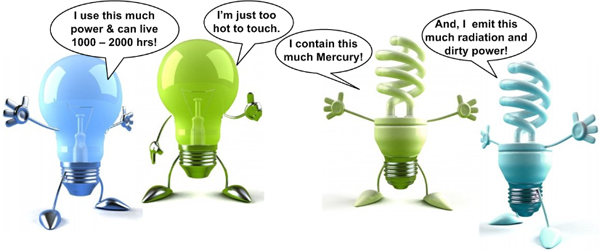
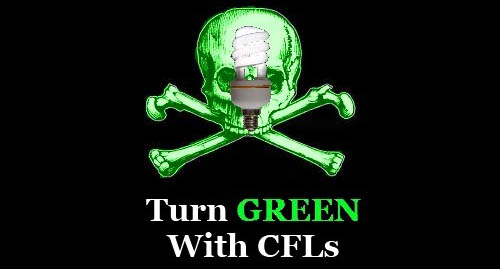
- CFLs contain mercury and have to be disposed of carefully. The amount of mercury in one bulb is enough to contaminate up to 6,000 gallons of water beyond safe drinking levels. The EPA recommends an elaborate cleanup ritual, including throwing away any clothes or bedding that has come in direct contact with the mercury from the bulb.
- CFLs are not designed to be turned off and on frequently; the lifespan of a CFL may be reduced by up to 85 percent if you switch it off and on a lot.
- People with certain health conditions can be harmed by CFLs. Reactions range from disabling eczema-like reactions, to light sensitivities that can lead to skin cancer.
- The Energy Star program warns that CFLs can overheat and smoke.
Bill Background
(reverse chronological order)July 08, 2011 - Bill Action
H.R. 91: Better Use of Light Bulbs Act Cosponsorship change.Rep. Reed [R-NY29]: Cosponsorship withdrawn.
June 24, 2011 - Bill Action
H.R. 91: Better Use of Light Bulbs Act Cosponsorship change.Rep. Latham [R-IA4]: New cosponsor.
June 15, 2011 - Bill Action
H.R. 91: Better Use of Light Bulbs Act Cosponsorship change.Rep. McKinley [R-WV1]: New cosponsor.
Rep. Rokita [R-IN4]:: New cosponsor.
Rep. Wolf [R-VA10]: New cosponsor.
Rep. Stivers [R-OH15]: New cosponsor.
Rep. Benishek [R-MI1]: New cosponsor.
June 01-02, 2011 - Bill Action
H.R. 91: Better Use of Light Bulbs Act Cosponsorship change.Rep. Griffith [R-VA9]: New cosponsor.
Rep. Smith [R-NE3]: New cosponsor.
May 26, 2011 - Bill Action
H.R. 91: Better Use of Light Bulbs Act Cosponsorship change.Rep. Gibson [R-NY20]: New cosponsor.
Rep. Noem [R-SD]: New cosponsor.
Rep. Smith [R-NJ4]:: New cosponsor.
Rep. Turner [R-OH3]: New cosponsor.
Rep. McKeon [R-CA25]: New cosponsor.
Rep. Duncan [R-SC3]: New cosponsor.
Rep. Herger [R-CA2]: New cosponsor.
Rep. Garrett [R-NJ5]: New cosponsor.
March 17, 2011 - Bill Action
H.R. 91: Better Use of Light Bulbs Act Cosponsorship change.Rep. Capito [R-WV2]: New cosponsor.
Rep. Ellmers [R-NC2]: New cosponsor.
Rep. Gibbs [R-OH18]: New cosponsor.
. Rep. Adams [R-FL24]: New cosponsor.
March 09, 2011 - Bill Action
H.R. 91: Better Use of Light Bulbs Act Cosponsorship change.Rep. Kline [R-MN2]: New cosponsor.
Rep. Fleming [R-LA4]: New cosponsor.
Rep. Fincher [R-TN8]: New cosponsor.
Rep. Johnson [R-OH6]: New cosponsor.
Rep. Walberg [R-MI7]: New cosponsor.
Rep. Rigell [R-VA2]: New cosponsor.
Rep. Posey [R-FL15]: New cosponsor.
Rep. Hultgren [R-IL14]: New cosponsor.
Rep. Farenthold [R-TX27]: New cosponsor.
Rep. Harris [R-MD1]: New cosponsor.
Rep. Flake [R-AZ6]: New cosponsor.
Rep. Price [R-GA6]: New cosponsor.
Rep. West [R-FL22]: New cosponsor.
Rep. Poe [R-TX2]: New cosponsor.
Rep. Franks [R-AZ2]: New cosponsor.
Rep. Olson [R-TX22]: New cosponsor.
Rep. Lamborn [R-CO5]: New cosponsor.
Rep. Neugebauer [R-TX19]: New cosponsor.
Rep. Yoder [R-KS3]: New cosponsor.
Rep. Pearce [R-NM2]: New cosponsor.
Rep. Walsh [R-IL8]: New cosponsor.
Rep. Schmidt [R-OH2]: New cosponsor.
March 01, 2011 - Bill Action
H.R. 91: Better Use of Light Bulbs Act Cosponsorship change.Rep. Goodlatte [R-VA6]: New cosponsor.
Rep. Sensenbrenner [R-WI5]: New cosponsor.
Rep. Murphy [R-PA18]: New cosponsor.
Rep. Reed [R-NY29]: New cosponsor.
Feb 10, 2011 - Bill Action
H.R. 91: Better Use of Light Bulbs Act Cosponsorship change.Rep. Nugent [R-FL5]: New cosponsor.
Rep. Holden [D-PA17]: New cosponsor.
Rep. Duncan [R-TN2]: New cosponsor.
Rep. Quayle [R-AZ3]: New cosponsor.
Jan 19, 2011 - Bill Action
H.R. 91: Better Use of Light Bulbs Act Cosponsorship change.Rep. Thompson [R-PA-5]: New cosponsor.
Rep. Hartzler [R-MO-4]: New cosponsor.
Rep. Woodall [R-GA-7]: New cosponsor.
Rep. Young [R-AK]: New cosponsor.
Rep. McCotter [R-MI-11]: New cosponsor.
Rep. Myrick [R-NC-9]: New cosponsor.
Rep. Flores [R-TX-17]: New cosponsor.
Jan 5, 2011 - Committee Assignments
Committees are like "mini Congresses". Most bills begin by being considered by one or several congressional committees which may "report" the bill favorably or unfavorably to the Senate or House as a whole allowing it to receive consideration by the full body and move forward, or may fail to consider a bill at all preventing the bill from moving forward. Most bills never receive any committee consideration and are never reported out. House bills start in House committees and enter Senate committees only after being passed by the House and received by the Senate, and similarly for Senate bills.
Information on committee proceedings is notoriously opaque: committees vary in what information they make public and often do not provide basic public information such as the results of votes electronically or in an understandable format. Furthermore, if your Member of Congress does not sit on any committee relevant to this bill, you generally have no opportunity to voice your opinion on the bill while the bill is receiving its most important consideration.
The bill has been referred to the following committees:House Energy and Commerce
House Transportation and Infrastructure
Jan 5, 2011 - HR 91: To repeal certain amendments to the Energy Policy and Conservation Act with respect to lighting energy efficiency, was introduced to the House of Representatives. This bill is in the first step in the legislative process. Introduced bills and resolutions first go to committees that deliberate, investigate, and revise them before they go to general debate. The majority of bills and resolutions never make it out of committee.
Other co-sponsors include: Reps.
Todd Akin (R-Missouri),
Rob Bishop (R-Utah),
Paul Broun (R-Georgia),
Ann Marie Buerkle (R-New York),
Dan Burton (R-Indiana),
Howard Coble (R-North Carolina),
Cynthia Lummis (R-Wyoming),
Tom McClintock (R-California),
Ron Paul (R-Texas),
Steve Scalise (R-Louisiana),
Cliff Stearns (R-Florida), and
Don Young (R-Alaska).
Sep 16, 2010 - As reported on GovTrack.us H.R. 6144: Better Use of Light Bulbs Act was introduced Sep 16, 2010 and referred to committee. This bill never became law. This bill was proposed in a previous session of Congress. Sessions of Congress last two years, and at the end of each session all proposed bills and resolutions that haven't passed are cleared from the books. Members often reintroduce bills that did not come up for debate under a new number in the next session.
The light bulb ban created such an uproar in New Zealand that it ushered in a new government and reversed the ban in 2008.
Here's an excerpt from a dialog in the New Zealand Parliament in December of 2008:
AARON GILMORE (National) to the Minister of Energy and Resources: Will the Government be moving to ban the sale of incandescent light bulbs?Energy and Resources Minister, Gerry Brownlee, has told Parliament... the ban on traditional light bulbs is being lifted.Hon GERRY BROWNLEE (Minister of Energy and Resources): I am delighted to inform the House that I have issued firm instructions to the Energy Efficiency and Conservation Authority to stop its plans to ban the sale of incandescent light bulbs. This Government, in stark contrast to the previous Government and the previous Minister of Energy, David Parker, rejects the idea that the Government knows best and must constantly meddle in the lives of New Zealanders. If people wish to buy incandescent light bulbs, then this Government will not stop them from doing so.
Aaron Gilmore: Why is the Government not going to ban incandescent light bulbs?
Hon GERRY BROWNLEE: There are a number of excellent reasons why we have not moved to ban those light bulbs. The first is that this Government believes that choice not compulsion, and the ability for individuals to make their own decisions about what sorts of lives they want to lead and what contribution they want to make to climate change, is far better than nanny State telling them what to do.
"This government has real concerns about telling people they have to move to energy efficient light bulbs by decree," he said."It has been well signaled and will come as no surprise that the government is lifting the ban on traditional or incandescent light bulbs," said Mr Brownlee.
"We are committed to energy efficiency in the home and efficient lighting has an important role to play in helping us reduce the amount of energy we use, but this Government believes it is a matter of consumer choice.
"People need good, credible information about the different lighting options that are available to them, and then they can decide what is right for them in their homes."
"Lifting the previous government's ban on incandescent light bulbs simply means we are allowing their continued sale, and I am confident the consumer trend to energy efficient bulbs will continue," said Mr Brownlee.
Why This Site Is Needed
As an individual who is very sensitive to fluorescent lighting, I became quite concerned that the Energy Independence and Security Act of 2007, signed into law on 19 December 2007, aims to phase out incandescent lighting by 2020. In 2012 the 1st phase is for 100 watt and 75 watt incandescent light bulbs to be banned. By 2014 the 60 watt and 40 watt incandescent light bulbs will be banned.
Prior to the passing of this legislation, Helen Irlen, the world expert in scotopic sensitivity syndrome, made the following statement:"Nearly one-quarter of the world's population will suffer negative physical effects if this legislation is allowed to pass. For this portion of the population, fluorescent light triggers headaches, migraines, stomachaches, fatigue, eye strain, anxiety, and irritability. Fluorescent lights can also negatively impact the immune system, literally making people sick. Energy conservation is an important goal that we should strive to achieve, but there are ways to conserve energy that do not hurt 25% of the population. Please don't let your government hurt the people you love. Please sign the petition and send this information to others asking them to sign the petition."
Helen L. Irlen, MA, LMFT
Executive Director
Irlen Institute International Headquarters
I am unclear exactly how this Act will affect having light sensitivity accommodated by employers and institutions in the future but it can't be good. I am concerned enough to establish this website to explore this issue and to work for legal accommodation/exception for all with light sensitivity.
Thank you for your support and concern.
Trishah Dee Woolley, M.A.